Why does bending your knees when you land from a jump protect your body? Why do airbags reduce injuries during a collision? And why do boxers “roll” with a punch instead of resisting the full force of it?
The answer lies in one powerful idea from physics: impulse and its relationship to the change in momentum of an object. Whenever a force acts on an object, it doesn’t just stop motion randomly.
In this article, we’ll break down what impulse really means, how mass and velocity determine momentum, and how this fundamental physics equation helps explain everything from sports safety to car crash protection.
First, What Is Momentum?
Momentum is often described as “motion that’s hard to stop.” The faster something moves and the heavier it is, the harder it is to bring to a stop. In physics, momentum helps us measure how much motion an object has.
Imagine a truck and a small ball moving at the same speed. Even if their speeds are equal, stopping the truck requires far more effort. Why? Because mass matters. Momentum depends on both mass and velocity.
The equation for momentum is:
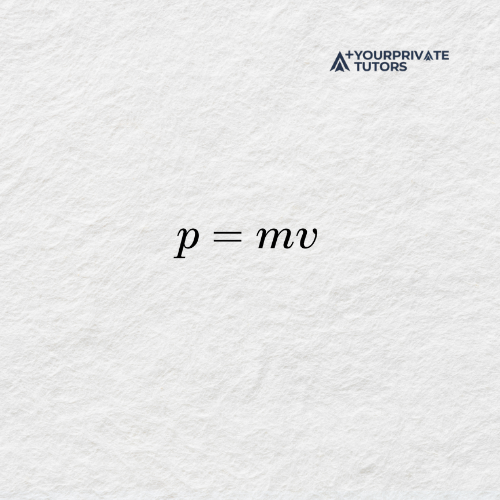
This means momentum (p) is equal to mass (m) multiplied by velocity (v). If mass is measured in kg and velocity in meters per second, then momentum is measured in kg·m/s.
Now, What Is Impulse?
If momentum tells us how much motion something has, impulse explains how that motion changes.
Impulse is what happens when a force acts on an object over a period of time. In other words, when you apply a force whether it’s a short hit or a steady push, you create impulse.
Think about hitting a ball. A quick strike and a longer push can involve the same force, but if the force acts for a longer time, the effect is different. Time matters.
Mathematically, impulse is written as:
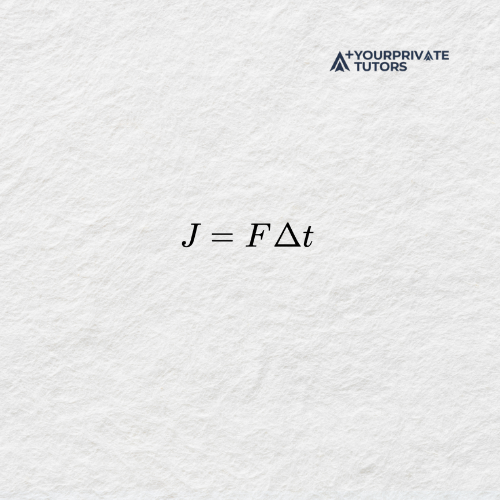
This means impulse (J) is equal to force (F), measured in newton (N), multiplied by the time interval (Δt). Because force is measured in newtons and time in seconds, impulse is measured in N·s (newton-seconds).
The Big Connection — The Impulse and Momentum Theorem
Here’s the key idea:
Impulse = Momentum Change
In physics terms, the impulse equation connects force, time, and motion in one clean relationship:
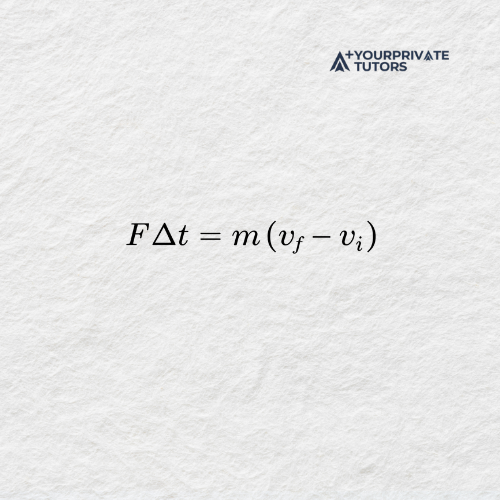
This means that when a net force acts on an object for a certain amount of time, the result is a change in velocity, which leads to a momentum change.
We can also write it like this:
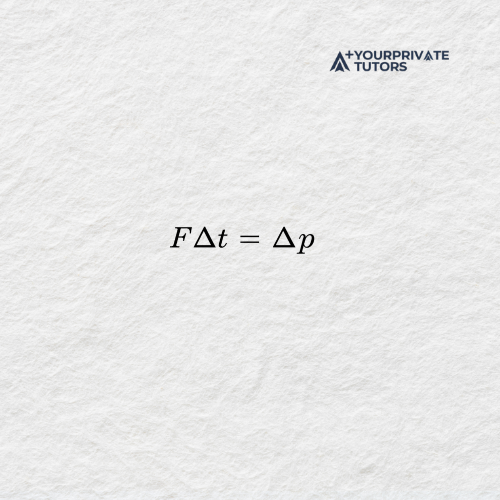
The impulse-momentum theorem states that the impulse applied to an object is equal to the change in its momentum. In other words, the impulse an object experiences is equal to the impulse needed to move it from its initial and final states of motion.
Master the Impulse & Momentum Theorem
Learn how the unit circle works with clear explanations, step-by-step guidance, and practical strategies that make sine, cosine, tangent, formulas, and identities easier to understand.
Why Increasing Time Reduces Force (This Is the Cool Part)
Now here’s where things get really interesting.
The theorem states that the impulse — force multiplied by time — is equal to the change in momentum. That means if the momentum change must stay the same, you can adjust either the force or the time.
If you increase the amount of time, the required force decreases.
Let’s look at real examples:
Airbags:
During a car crash, the passenger’s body must undergo a rapid momentum change. Using the impulse-momentum theorem, engineers design airbags to increase the time over which the stopping happens. Because the time increases, the force exerted on the body decreases.
Catching a Ball:
When you catch a fast-moving ball, you naturally move your hands backward. Why? To increase the stopping time. The ball’s initial and final momentum must change from moving to stopped. By increasing time, you reduce the force your hands feel.
Gymnast Landing:
When a gymnast lands and bends their knees, they increase the time it takes to stop. The impulse required to stop their motion is equal to the change in momentum, but spreading it out over more time reduces the peak force.
Common Mistakes Students Make
Understanding impulse and momentum is straightforward, but a few common mistakes show up again and again.
1. Thinking Impulse = Force
Impulse is not just force. Impulse depends on both force and time.
A small force applied for a long time can produce the same momentum change as a large force applied briefly. Since impulse includes time, you must always consider how long the force is applied.
2. Forgetting Momentum Is a Vector
Momentum is not a scalar. It has direction.
Students often ignore negative signs when calculating change in momentum. But direction matters, especially when objects collide or reverse motion.
The negative sign simply shows direction — not an error.
3. Ignoring Time in Collisions
When objects collide, students often focus only on force. But since impulse depends on force and time, collision duration is critical.
Two collisions with the same momentum change can feel very different depending on how long the contact lasts.
4. Mixing Up Newton’s Second Law and Impulse
Newton’s second law describes how force causes acceleration. The impulse-momentum idea extends this by connecting force and time directly to change in momentum.
They are related — impulse actually comes from Newton’s second law — but they’re applied differently depending on the situation.
5. Forgetting That External Forces Matter
Only a net external force can change the momentum of the object. If no net force acts, momentum stays constant.
Conclusion
The impulse and momentum theorem isn’t just another physics formula to memorize — it’s a powerful way of understanding how motion changes in the real world. From airbags and crumple zones to athletes catching a ball or bending their knees after a jump, the same principle is always at work: when a force acts over time, it changes momentum in a predictable way.
Once you see that impulse equals change in momentum, collisions stop feeling mysterious. You begin to understand why increasing stopping time reduces force, why direction matters, and how Newton’s laws connect everything together. It’s one of those concepts that, once it clicks, makes a huge part of physics feel much more logical.
If you’re still finding parts of momentum, impulse, or collision problems challenging, that’s completely normal. These ideas build on several foundational concepts, and sometimes a step-by-step walkthrough with a knowledgeable tutor can make all the difference.
If you’d like more personalized guidance, the experienced tutors at Your Private Tutors can help you strengthen your understanding, practice problem-solving techniques, and gain confidence in physics.