Math students often hit a wall when exponential and logarithmic functions appear in Algebra 2 or Precalculus. The equations suddenly look unfamiliar, the graphs behave differently, and simple linear patterns no longer apply. That confusion is common and it matters more than many students realize.
According to the National Assessment of Educational Progress (NAEP), only 26% of U.S. eighth-grade students performed at or above the proficient level in mathematics in 2024, highlighting ongoing struggles with foundational algebra concepts that directly impact higher-level topics like exponents and logarithms. Meanwhile, the U.S. Bureau of Labor Statistics projects that science, technology, engineering, and mathematics (STEM) occupations will continue growing faster than average through 2033, increasing the importance of strong mathematical reasoning skills.
Exponential and logarithmic functions are not just textbook topics. They help explain everything from compound interest and population growth to earthquake intensity and computer algorithms. Once students understand the relationship between logarithmic and exponential functions, many problems that once felt impossible start making sense.
The challenge is rarely intelligence. More often, students struggle because these ideas are introduced too quickly without enough real-world context or step-by-step explanation. With the right approach, exponential equations, logarithms, and inverse functions become far more manageable and even surprisingly logical.
What Are Exponential and Logarithmic Functions?
Exponential and logarithmic functions are closely connected mathematical concepts used to describe growth, decay, and inverse relationships. They appear throughout algebra, science, finance, and technology because they model situations that change rapidly over time.
An exponential function involves a variable placed in the exponent. Instead of increasing by the same amount repeatedly, the output changes by multiplication. This creates patterns of rapid growth or rapid decay.
A logarithmic function works in the opposite direction. Instead of asking, “What is the result?” a logarithm asks, “What exponent created this result?”
One reason these topics feel challenging is that they introduce a completely different way of thinking about numbers and relationships. Unlike linear equations, exponential and logarithmic functions often change dramatically over short intervals.
Understanding the Meaning of an Exponent
An exponent tells you how many times a number is multiplied by itself.
For example:
23 = 2 × 2 × 2 = 8
The small raised number (3) is the exponent, and the larger number (2) is the base.
Students usually first encounter positive exponents, but exponents can also be:
- Negative
- Zero
- Fractional
Here are a few examples:
| Expression | Meaning | Result |
|---|---|---|
| 52 | 5 × 5 | 25 |
| 20 | Any nonzero number to the zero power | 1 |
| 3−2 | Reciprocal of 32 | 1/9 |
| 161/2 | Square root of 16 | 4 |
Many students struggle with negative and fractional exponents because they seem to “break” earlier rules. In reality, they extend those rules in predictable ways.
The more comfortable students become with exponents, the easier logarithms become later.
What Is a Base in Math Functions?
The base is the number being repeatedly multiplied in an exponential expression or referenced in a logarithm.
For example:
25
The base is 2.
In logarithms:
log2(32) = 5
The base is still 2 because 2 raised to the fifth power equals 32.
Common bases include:
The base is still 2 because 2 raised to the fifth power equals 32.
Common bases include:
- Base 10 (common logarithm)
- Base e (natural logarithm)
- Base 2 (computer science and binary systems)
The base matters because it changes how quickly a function grows or decays.
For example:
The base matters because it changes how quickly a function grows or decays.
For example:
- 2x grows steadily
- 10x grows extremely quickly
- (1/2)x represents exponential decay
Changing the base completely changes the graph and behavior of the function.
Real-Life Example of Exponential Growth and Decay
Students often understand these functions more easily once they see them outside the classroom.
Population growth
A bacteria colony doubling every hour follows an exponential growth pattern.
| Hour | Population |
|---|---|
| 0 | 100 |
| 1 | 200 |
| 2 | 400 |
| 3 | 800 |
The increase becomes dramatic very quickly.
Compound interest
Money invested with compound interest grows exponentially because interest is continually added to the balance.
For example, saving $1,000 at 5% annual interest produces growth like this:
A = 1000(1.05)t
Radioactive decay
Some substances lose half their mass over fixed time intervals. This is exponential decay.
Viral social media trends
A video shared by one person, then ten, then one hundred, can spread exponentially across platforms within hours.
These examples help students recognize that exponential behavior appears naturally in the real world not just in textbooks.
Understanding the Exponential Function
An exponential function describes situations where values increase or decrease by multiplication instead of addition.
Linear functions grow steadily. Exponential functions accelerate.
Compare these patterns:
| x | Linear: y = 2x | Exponential: y = 2x |
|---|---|---|
| 1 | 2 | 2 |
| 2 | 4 | 4 |
| 3 | 6 | 8 |
| 4 | 8 | 16 |
| 5 | 10 | 32 |
At first, the difference seems small. Then the exponential function grows dramatically faster.
Graphs of exponential functions typically:
- Curve upward or downward
- Never touch the x-axis
- Show rapid change over time
This visual behavior is important for interpreting real-world models.
General Form of an Exponential Function
The standard form of an exponential function is:
Where:
- a = starting value
- b = growth or decay factor
- x = exponent
- y = output
If:
- b>1, the function shows exponential growth
- 0<b<1, the function shows exponential decay
Example:
This means:
- The initial value is 3
- The output doubles each time x increases by 1
The exponent controls how rapidly the function changes.
Key Properties of an Exponential Function
Exponential functions have several important properties students should recognize.
Rapid growth and decay
Small increases in the exponent can create huge changes in output.
Horizontal asymptotes
Most exponential graphs approach but never touch the x-axis.
Domain and range
Domain: all real numbers
Range: positive numbers only (in most basic functions)
Increasing vs. decreasing functions
- Bases greater than 1 create increasing graphs
- Bases between 0 and 1 create decreasing graphs
Recognizing these patterns helps students sketch graphs and interpret equations more confidently.
Example Problems Using Exponential Functions
Working through examples step by step often makes these concepts feel less intimidating.
Example 1: Evaluating an exponential function
Find the value of:
y = 24
Solution:
Example 2: Exponential growth problem
A savings account starts with $500 and grows by 10% annually.
Equation:
A = 500(1.10)t
After 3 years:
A = 500(1.10)3
A ≈ 665.50
The account balance becomes approximately $665.50.
Example 3: Graph interpretation
Suppose a graph rises slowly at first and then sharply upward.
This usually indicates:
- Exponential growth
- A base larger than 1
Increasing output over time
Students who connect equations with graph behavior tend to solve problems more accurately.
24 = 2 × 2 × 2 × 2 = 16
Answer: 16
What Is a Logarithmic Function?
A logarithmic function is the inverse of an exponential function.
Instead of calculating the result of repeated multiplication, logarithms determine the exponent needed to produce a number.
For example:
23 = 8
can also be written as:
log2(8) = 3
The logarithm answers the question:
“What exponent should 2 be raised to in order to get 8?”
This relationship is why logarithms and exponents are deeply connected.
Logarithms become especially useful when:
- Solving exponential equations
- Working with scientific data
- Measuring large scales
- Simplifying multiplication-heavy calculations
Many students initially find logarithmic notation confusing because it looks unfamiliar. Once they understand that logarithms simply “undo” exponents, the concept becomes much clearer.
General Form of a Logarithmic Function
The standard logarithmic function is:
Where:
- b = base
- x = argument
- y = exponent produced
Important restrictions:
- The base must be positive and not equal to 1
- The argument must be greater than 0
For example:
log3(27) = 3
because:
33 = 27
Students often forget that logarithms cannot accept zero or negative numbers as inputs. This restriction becomes important when solving equations.
Common Logarithm vs. Natural Logarithm
Two logarithms appear frequently in algebra and science.
log(100) = 2
because:
102 = 100
Common logarithms are widely used in:
- Scientific notation
- Engineering
- Data analysis
Natural logarithm
The natural logarithm uses base e, where:
Common logarithm
The common logarithm uses base 10.
Natural logarithm
The natural logarithm uses base e, where:
e ≈ 2.718
It is written as:
ln(x)
Natural logarithms appear often in:
- Calculus
- Physics
- Compound growth models
- Population studies
Students frequently use the natural logarithm to solve exponential equations involving the constant e.
Important Properties of Logarithms
Logarithm properties help simplify complicated expressions.
Product property
logb(MN) = logb(M) + logb(N)
Quotient property
logb(M/N) = logb(M) − logb(N)
Power property
logb(Mp) = p logb(M)
Change-of-base property
logb(M) = log(M)⁄log(b)
These properties are essential when simplifying expressions and solving logarithmic equations.
The Relationship Between Logarithmic and Exponential Functions
One of the most important ideas in algebra is understanding the relationship between logarithmic and exponential functions.
They are inverse functions, meaning they undo each other.
This relationship explains why students often use logarithms to solve exponential equations.
How Logarithmic and Exponential Functions Are Inverses
Consider the exponential equation:
25 = 32
Equivalent logarithmic form:
log2(32) = 5
The exponential form gives the result.
The logarithmic form asks for the exponent.
Understanding this conversion helps students move smoothly between equations.
Inverse relationships matter because they allow mathematicians to:
- Solve unknown exponents
- Simplify calculations
- Model real-world growth and decay
Graphing the Relationship Between Logarithmic and Exponential Functions
Graphs help visualize inverse functions clearly.
The graphs of:
- y = 2x
- y = log2(x)
are reflections of each other across the line:
| Exponential Function | Logarithmic Function |
|---|---|
| Domain: all real numbers | Domain: positive numbers |
| Range: positive numbers | Range: all real numbers |
| Horizontal asymptote | Vertical asymptote |
Seeing these graphs side by side helps students recognize how the functions mirror one another.
Example Conversions Between Exponential and Logarithmic Form
Example 1
Convert:
53 = 125
to logarithmic form.
Answer:
log5(125) = 3
Example 2
Convert:
log4(64) = 3
to exponential form.
Answer:
43 = 64
Common student mistakes include:
- Mixing up the base and exponent
- Forgetting which number becomes the argument
- Writing logarithms backward
Practicing conversions regularly builds confidence quickly.
How to Solve Exponential Equations
Solving exponential equations becomes easier once students recognize patterns and know when logarithms are necessary.
Some equations can be solved by rewriting both sides with the same base. Others require logarithmic methods.
Solving Exponential Equations with the Same Base
Consider:
2x+1 = 16
Rewrite 16 as a power of 2:
16 = 24
Now:
2x+1 = 24
Since the bases match, set the exponents equal:
x + 1 = 4
x = 3
This strategy works well when numbers share a common base.
Using Logarithms to Solve Exponential Equations
Some equations cannot be rewritten neatly.
Example:
3x = 20
Take the logarithm of both sides:
log(3x) = log(20)
Apply the power property:
x log(3) = log(20)
Solve:
x = log(20)⁄log(3)
Students can also use the natural logarithm:
x = ln(20)⁄ln(3)
Both methods produce the same answer.
Real-World Example Problems
Interest formula
A bank account doubles every 12 years.
Equation:
A = P(2)t/12
Students can use logarithms to determine how long it takes for money to reach a target amount.
Growth models
Scientists use exponential equations to model bacteria growth and population increases.
Scientific applications
Radioactive decay calculations help scientists estimate the age of ancient objects using exponential decay formulas.
These applications show students why exponential and logarithmic functions remain essential far beyond algebra class.
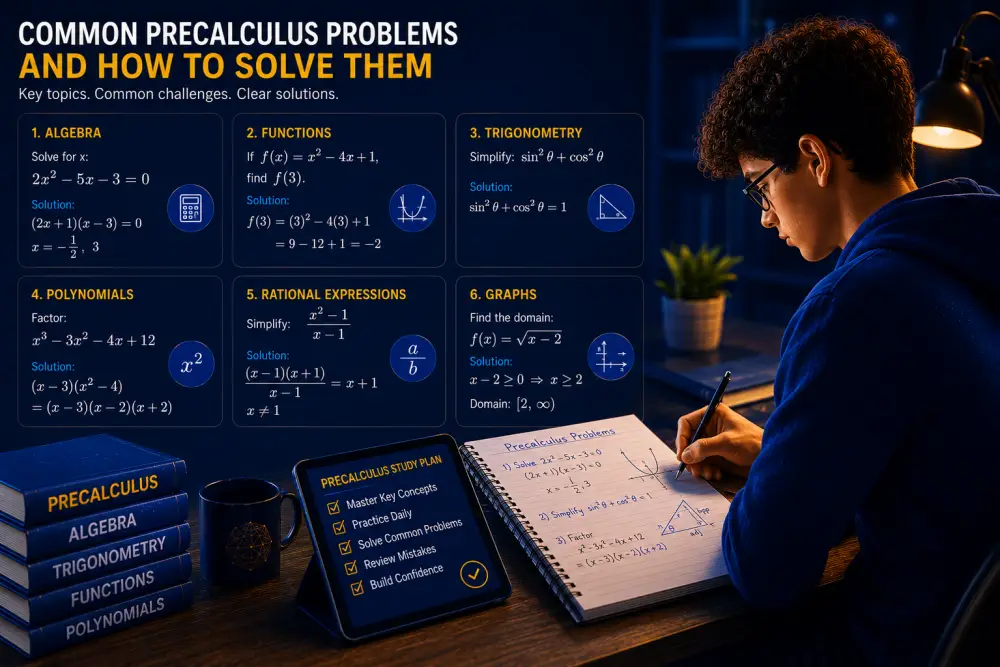
Common Precalculus Problems and How to Solve Them
Precalculus problems feel confusing? This free learning guide simplifies pre-calculus step by step so you can understand concepts and improve faster
Common Properties and Rules Students Should Memorize
Exponential and logarithmic functions become much easier once students memorize a few core rules.
Instead of trying to “guess” through problems, students can rely on patterns and relationships that work consistently.
Creating a quick-reference sheet with formulas, examples, and exponent rules often improves both speed and confidence during homework and exams.
Exponent rules every student needs
Exponent rules appear throughout algebra, precalculus, physics, and computer science. Students who know these rules well typically solve equations much faster.
Product rule
When multiplying powers with the same base, add the exponents.
am · an = am+n
Students often confuse negative exponents with negative numbers. Practicing these examples helps reinforce the distinction.
Logarithm properties explained simply
Logarithm rules mirror exponent rules in many ways.
Understanding these relationships helps students simplify complex equations more efficiently.
Example:
23 × 24 = 27 = 128
Quotient rule
When dividing powers with the same base, subtract the exponents.
am⁄an = am−n
Example:
56⁄52 = 54
Zero exponent rule
Any nonzero number raised to the zero power equals 1.
a0 = 1
Example:
70 = 1
Negative exponent rule
A negative exponent creates a reciprocal.
a−n = 1⁄an
Example:
2−3 = 1⁄8
Students often confuse negative exponents with negative numbers. Practicing these examples helps reinforce the distinction.
Logarithm properties explained simply
Logarithm rules mirror exponent rules in many ways.
Understanding these relationships helps students simplify complex equations more efficiently.
Product property
logb(MN) = logb(M) + logb(N)
Multiplication inside a logarithm becomes addition outside it.
Quotient property
logb(M/N) = logb(M) − logb(N)
Division inside becomes subtraction outside.
Power property
logb(Mp) = p logb(M)
An exponent becomes a coefficient in front of the logarithm.
Inverse properties
Exponential and logarithmic functions cancel one another.
blogb(x) = x
and
logb(bx) = x
These inverse relationships are central to solving equations involving logarithms.
Quick comparison table of exponential and logarithmic rules
| Concept | Exponential Rule | Logarithmic Rule |
|---|---|---|
| Multiplication | am · an = am+n | log(MN) = log(M) + log(N) |
| Division | am/an = am−n | log(M / N) = log(M) − log(N) |
| Powers | (am)n = amn | log(Mn) = n log(M) |
| Inverse relationship | bx = y | logb(y) = x |
Many students find it helpful to study exponent rules and logarithm rules side by side because the patterns become easier to recognize.
Common Mistakes in Exponential and Logarithmic Functions
Even strong math students make predictable mistakes when learning exponents and logarithms.
Most errors happen because students:
- Apply the wrong property
- Forget restrictions
- Misuse the calculator
- Rush through algebra steps
Recognizing these patterns early can save significant frustration later.
Misunderstanding the base and exponent
Students frequently mix up the base and exponent in exponential expressions.
Example mistake:
23 = 6
Incorrect.
The correct calculation is:
2 × 2 × 2 = 8
Another common issue appears when simplifying powers.
Incorrect:
(23)2 = 25
Correct:
(23)2 = 26
For example:
- 2x means multiplication
- 2x represents an exponential function
That small difference changes the entire meaning of the equation.
Forgetting logarithm restrictions
A logarithmic function only works when the input is positive.
These expressions are undefined:
log(0)
and
log(−5)
Students sometimes solve equations correctly algebraically but forget to test whether the logarithm itself is valid.This issue becomes especially important when working with fractions, radicals, or variables inside logarithms.Errors when solving equationsSome mistakes happen simply because students try to move too quickly.Common examples include:- Applying logarithm rules incorrectly
- Dropping parentheses
- Entering equations improperly into a calculator
- Rounding too early during multi-step problems
- Keep exact values throughout the calculation
- Round only at the end
- log (common logarithm)
- ln (natural logarithm)
Practical Applications of Logarithmic and Exponential Functions
One reason exponential and logarithmic functions matter so much is that they appear constantly in real-world situations.
Students often become more motivated when they realize these concepts help explain everything from money growth to sound intensity and earthquake measurements.
Exponential functions in finance and science
Exponential functions are commonly used whenever growth or decay happens repeatedly over time.
Compound interest
Banks use exponential equations to calculate how investments grow.
Example:
A = P(1 + r)t
Even small interest rates can produce significant long-term growth because the interest compounds repeatedly.
Population growth
Scientists model population changes using exponential growth equations.
A city population doubling every few decades follows exponential behavior rather than linear growth.
Half-life calculations
Radioactive materials decay exponentially.
Scientists use these models to:
- Estimate the age of fossils
- Study medical isotopes
- Analyze environmental data
This concept is especially important in chemistry and physics.
Logarithmic functions in technology and nature
Logarithms help simplify very large or very small measurements into manageable scales.
Earthquake scales
The Richter scale uses logarithms.
An earthquake measuring 6 is not just slightly stronger than one measuring 5 it releases far more energy.
Sound intensity
Decibel scales measure sound intensity logarithmically.
This explains why a rock concert sounds dramatically louder than ordinary conversation.
pH scale applications
The pH scale in chemistry is logarithmic.
A solution with a pH of 3 is ten times more acidic than a solution with a pH of 4.
These examples show why logarithmic functions remain essential across science, medicine, and engineering.
Why understanding these functions matters for students
Exponents and logarithms appear in:
- Standardized testing
- Advanced algebra
- Calculus
- Data science
- Computer science
- Engineering programs
Students who master these topics early often transition more smoothly into higher-level mathematics.
Resources like Your Private Tutor can help reinforce classroom instruction, but many students also benefit from guided tutoring support when concepts become more abstract.
Tips for Learning Exponential and Logarithmic Functions More Easily
Many students assume they are “bad at math” when logarithms feel confusing. In reality, these topics simply require a different style of thinking and consistent practice.
Small study habits often make a bigger difference than natural ability.
Best study habits for algebra success
Students who improve most consistently usually focus on repetition and pattern recognition.
Helpful strategies include:
- Practicing a few problems daily instead of cramming
- Creating flashcards for logarithm rules
- Writing out exponent rules by hand
- Sketching graphs repeatedly
- Solving both exponential and logarithmic forms of the same equation
Graphing exercises are especially useful because they help students visualize inverse relationships.
Even spending 10 to 15 minutes reviewing concepts regularly can improve long-term retention significantly.
When to use a calculator
Scientific calculators are helpful tools, but students should understand the math before relying on them.
A calculator becomes most useful when:
- Evaluating complicated logarithms
- Checking answers
- Estimating large exponents
- Solving decimal approximations
Students should learn where the:
- log button
- ln button
- exponent key
are located before exams.
However, depending entirely on a calculator can create problems if students do not understand the underlying method or equation structure.
Practice resources and tutoring support
Sometimes students need additional explanation beyond classroom instruction.
Helpful resources include:
- Algebra worksheets
- Online graphing calculators
- One-on-one tutoring sessions
Personalized tutoring can be especially valuable because it allows students to:
- Ask questions freely
- Work through mistakes step by step
- Build confidence gradually
- Learn at their own pace
Many students improve dramatically once concepts are explained in a way that matches their learning style.
Small steps build real math confidence



Ready to Master Exponential and Logarithmic Functions With More Confidence?
Exponential and logarithmic functions can seem overwhelming at first, but they become far more manageable once students understand the patterns behind the equations.
The key is consistent practice, clear explanations, and learning how each function connects to the next. Even students who initially struggle with logarithms often improve quickly once they work through guided examples and visual models step by step.
If your child needs extra support with exponents and logarithms, Your Private Tutor provides personalized academic guidance designed to build both understanding and confidence. Our experienced tutors help students strengthen algebra foundations, prepare for exams, and approach challenging math topics with less stress and more clarity.
To learn more about how Your Private Tutor can help your student succeed, contact our team today and explore tutoring support tailored to your child’s learning needs.