Ever looked at your math schedule and thought… “Wait, what even is precalculus?”
You’re not alone.
A lot of students see precalculus or pre-calculus on their timetable and assume it’s just “harder algebra.” Others hear the word calculus and immediately panic a little.
Here’s the truth.
Precalculus is less about making math scarier and more about connecting everything you’ve already learned so it finally makes sense.
Think of it as the bridge between algebra, trigonometry, and the world of calculus. And once you get that, it stops feeling random and starts feeling… surprisingly logical.
Why Precalculus Matters for Students
Let’s be real. It’s easy to wonder, “Do I actually need this?”
Short answer: yes, especially if calculus is anywhere in your future.
Precalculus is a prerequisite for calculus, which means skipping it would be like trying to watch season 3 of a show without seeing the first two. Confusing. Slightly chaotic. Not recommended.
Here’s why it matters:
1. It Builds the Math Skills You’ll Actually Use
Precalculus strengthens your understanding of algebra, trigonometry, and geometry. These are the exact tools used in calculus concepts like derivatives and integrals.
Without that foundation, finding the derivatives or understanding rates of change becomes way harder than it needs to be.
2. It Connects Everything You’ve Learned
Earlier math courses often feel disconnected.
Precalculus changes that.
You’ll see how:
- Algebra and geometry link through graphs
- Trigonometric functions model real patterns
- Equations and inequalities describe real situations
It turns math into a system instead of a checklist.
3. It Supports Your Academic Journey
Whether you’re:
- Planning for college
- Looking to earn college credits
- Exploring a future career path in science, tech, or business
Precalculus plays a key role.
It’s used in fields like engineering, economics, medicine, and data science. So even if you’re not “a math person,” it still opens doors.
4. It Makes Calculus Way Less Scary
Here’s a secret.
Students who struggle in calculus usually don’t struggle because calculus is impossible. They struggle because their precalculus foundation isn’t solid.
Precalculus prepares students for calculus by making sure you already understand:
- Functions
- Graph behavior
- Exponential and logarithmic functions
- Trigonometric relationships
So when calculus shows up, it feels familiar, not overwhelming.
What Makes Precalculus So Challenging?
Let’s be honest.
Precalculus doesn’t gently “level up” from algebra. It jumps.
One day you’re solving a quadratic equation.
The next, you’re dealing with trigonometric functions, rational functions, and inverse functions all in one week.
Here’s why many students struggle:
1. It combines multiple math worlds
You’re no longer just doing algebra. You’re mixing algebra and trigonometry, plus elements of geometry and early calculus thinking.
2. The pace is faster
High school math courses don’t always slow down for deep understanding. Concepts like exponential and logarithmic functions can feel rushed.
3. It’s more conceptual
It’s not just solving an equation anymore.
It’s understanding why functions behave the way they do.
4. The topics feel abstract
From complex numbers to polar coordinates and even ideas connected to Leonhard Euler, things can feel far removed from everyday life.
And that’s usually the moment students think:
“Maybe I’m just not a math person.”
Spoiler: that’s almost never true.
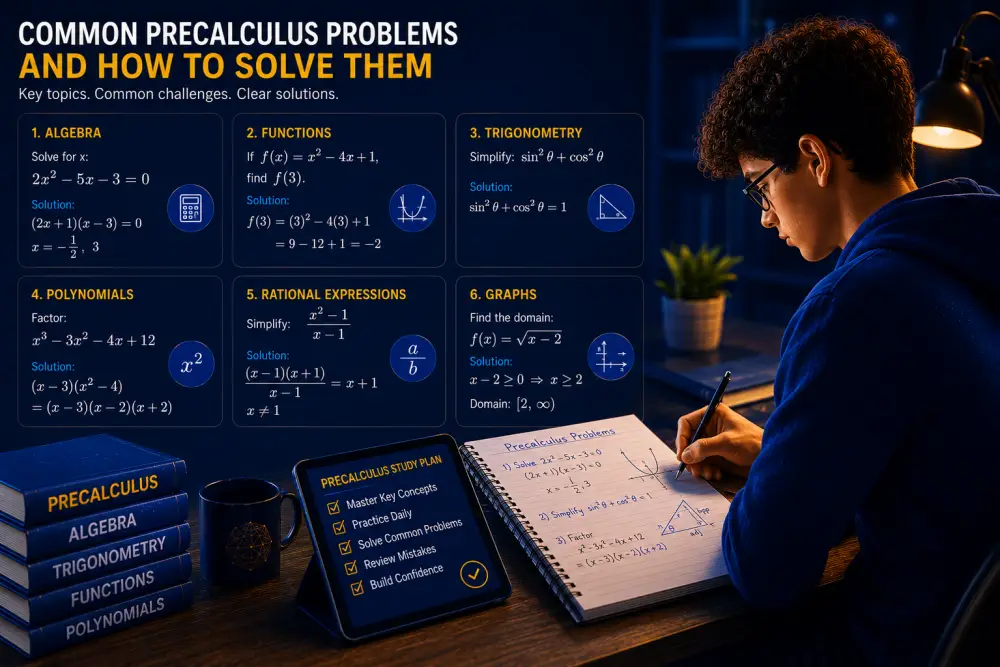
Common Precalculus Problems and How to Solve Them
Precalculus problems feel confusing? This free learning guide simplifies pre-calculus step by step so you can understand concepts and improve faster
What Topics Are Covered in Precalculus?
Alright, let’s talk about what you’ll actually learn.
The course content might sound like a lot at first, but it’s really a mix of ideas you’ve seen before plus some new twists.
Core Precalculus Topics
This is where your algebra skills level up.
You’ll work on:
- Equations and inequalities
- Systems of equations
- Polynomial and quadratic functions
- Rational functions
You’ll also dive deeper into graphing. Not just plotting points, but understanding what the graph is telling you.
Trigonometry in Precalculus
This is where things get a bit more interesting.
You’ll explore:
- Trigonometric functions like sine, cosine, and tangent
- Trigonometric identities
- How angles and waves relate to real-world patterns
This part is huge because trigonometry is used in calculus and in many real-world applications like physics and engineering.
Advanced Functions and Concepts
Here’s where precalculus starts to feel more “next level.”
You’ll learn about:
- Exponential and logarithmic functions
- Inverse functions
- Sequences and series
These ideas are essential because they show up directly in calculus concepts and are used in fields like finance and science.
Additional Mathematical Topics
Depending on your course, you might also cover:
- Complex numbers
- Matrices (yes, the matrix kind, but less sci-fi)
- Conic sections like circles, ellipses, and hyperbolas
- Connections between algebra and geometry
All of these help build a deeper understanding of how mathematical systems work.
How Precalculus Connects to Calculus
Here’s where everything starts to click.
Precalculus isn’t just “before calculus” in name. It’s literally building the tools you’ll use every single day in calculus.
When you get to calculus, you’ll study things like:
- Derivatives and antiderivatives
- How functions change over time
- Slopes of curves instead of straight lines
But here’s the catch.
Calculus assumes you already understand functions, graphs, and algebra really well.
That’s exactly what a precalculus course does.
For example:
- When you learn how to analyze a graph in precalculus, you’re preparing to understand slopes in calculus
- When you study exponential functions, you’re setting up for growth and decay problems later
- When you work with trigonometry, you’re preparing for trigonometric calculus problems
So instead of learning totally new ideas, calculus becomes an extension of what you already know.
Precalculus makes calculus feel less like a shock… and more like a sequel.
Precalculus vs Algebra and Trigonometry
At first glance, it’s easy to think:
“Wait… didn’t I already do algebra and trigonometry?”
Yes. But precalculus takes those ideas and levels them up.
Algebra
In earlier math courses, algebra is mostly about solving an equation.
In precalculus, algebra becomes more about:
- Understanding how functions behave
- Connecting equations to graphs
- Working with more complex expressions
It’s less “solve this” and more “understand what’s happening.”
Trigonometry
Basic trigonometry focuses on triangles and angles.
Precalculus goes further:
- You’ll work with trigonometric functions as graphs
- You’ll explore patterns and identities
- You’ll see how trigonometry connects to real-world models
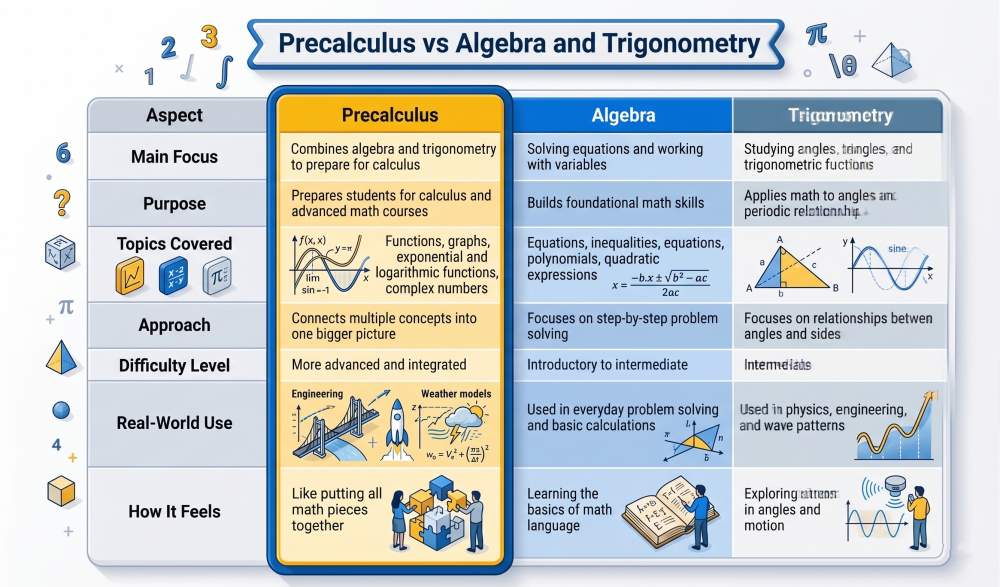
So What’s Different About Precalculus?
Precalculus combines algebra and trigonometry into one system.
Instead of learning topics separately, you start seeing how everything fits together. That’s why many students say precalculus feels more challenging… but also more meaningful.
What to Expect in a Precalculus Course
Walking into a precalculus course can feel a bit intimidating. But once you know what to expect, it’s much more manageable.
1. A Mix of Familiar and New Topics
You’ll revisit ideas from:
- Algebra
- Trigonometry
- Even a bit of geometry
But the topics covered will go deeper and connect more than before.
2. A Strong Focus on Functions and Graphs
Functions are the main character of precalculus.
You’ll spend a lot of time:
- Graphing functions
- Interpreting what those graphs mean
- Connecting equations to visual patterns
3. More Problem Solving, Less Memorizing
Yes, there are formulas.
But success in precalculus comes more from understanding than memorization. You’ll be asked to think, not just repeat steps.
4. Preparation for Future Math Courses
This course content is designed to prepare you for:
- Calculus
- College algebra
- Other advanced math courses
So even when something feels tough, it’s building skills you’ll use again.
If things start to feel overwhelming, working with precalculus tutors can help break down complex topics into something much more manageable.
Should You Take a Precalculus Online Course?
Short answer: it can be a game changer.
An online course gives you flexibility that a classroom sometimes can’t.
Why Students Choose an Online Course
- You can learn at your own pace
- You can replay explanations (which is honestly underrated)
- You can focus more on the topics you find difficult
When It Helps Most
An online course is especially useful if:
- You feel lost in class and need a different explanation
- You want to get ahead before starting calculus
- You’re balancing a busy schedule
Extra Support Makes a Difference
Pairing an online course with precalculus tutoring gives you both flexibility and personalized guidance, which can make a big difference.
An online precalculus tutor can focus on your exact questions, whether you’re stuck on functions, graphs, or tricky concepts.

How To Master Precalculus with Expert Online Tutors
Precalculus feels confusing with trigonometry and algebra? This guide simplifies pre-calculus concepts and builds mathematical skills for calculus success
Is Precalculus Right for You?
If you’re asking this, you’re already thinking ahead. That’s a good sign.
Precalculus is a great choice if:
- You’re planning to take calculus
- You’re considering a career path that involves math, science, or technology
- You want to strengthen your overall mathematical skills
Even if you’re unsure about your future, precalculus keeps your options open.
A Final Thought
Precalculus might feel like a big step. And honestly, it is.
But it’s also the point where math starts making more sense as a whole. You’re not just solving random problems anymore. You’re building a foundation for calculus, future math courses, and real-world applications.
And here’s something worth remembering. You don’t have to figure it all out on your own.
If you ever feel stuck, confused, or just want a boost in confidence, getting the right support can make all the difference. Whether it’s help with tricky topics covered in your precalculus course or preparing for what’s next, having someone guide you can turn frustration into progress.
If you need help, feel free to reach out to us at Your Private Tutor. We’re here to support you, answer your questions, and help you move forward with confidence.